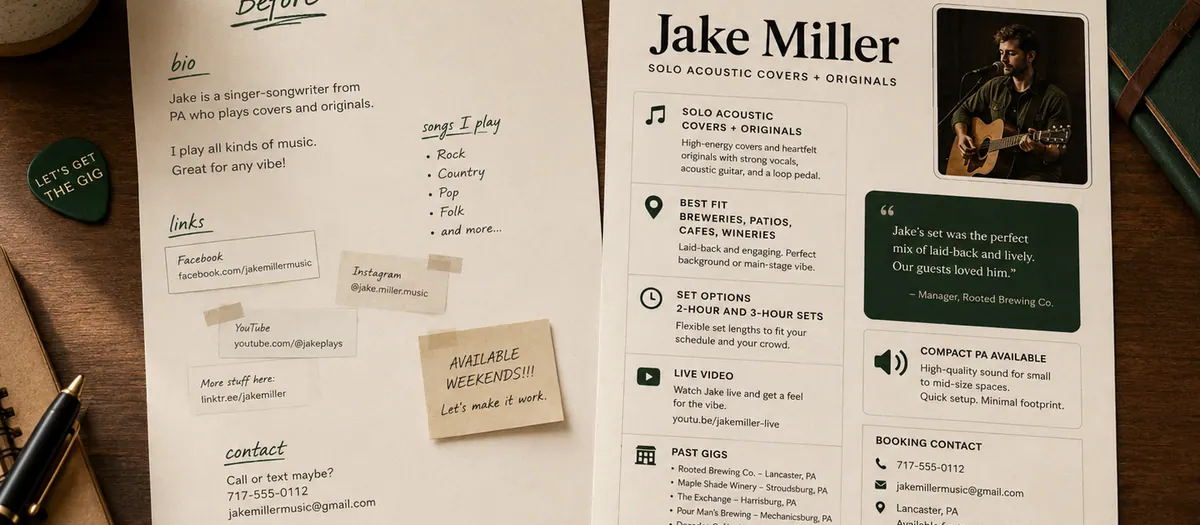
Lead with the act a venue can book
The first sentence should identify the artist, home area, act configuration, and sound. A venue should not need three paragraphs to learn whether you are a solo acoustic performer, duo, cover band, or original full band.
Describe the room experience in concrete language. Relaxed patio set, danceable weekend covers, intimate songwriter show, and high-energy original rock bill communicate more than broad claims such as unique, dynamic, or unforgettable.
- Artist or band name
- Home area and realistic market
- Solo, duo, or band configuration
- Specific sound and repertoire
- Set length or live format when useful
- The rooms and audiences that fit
Use a simple bio formula
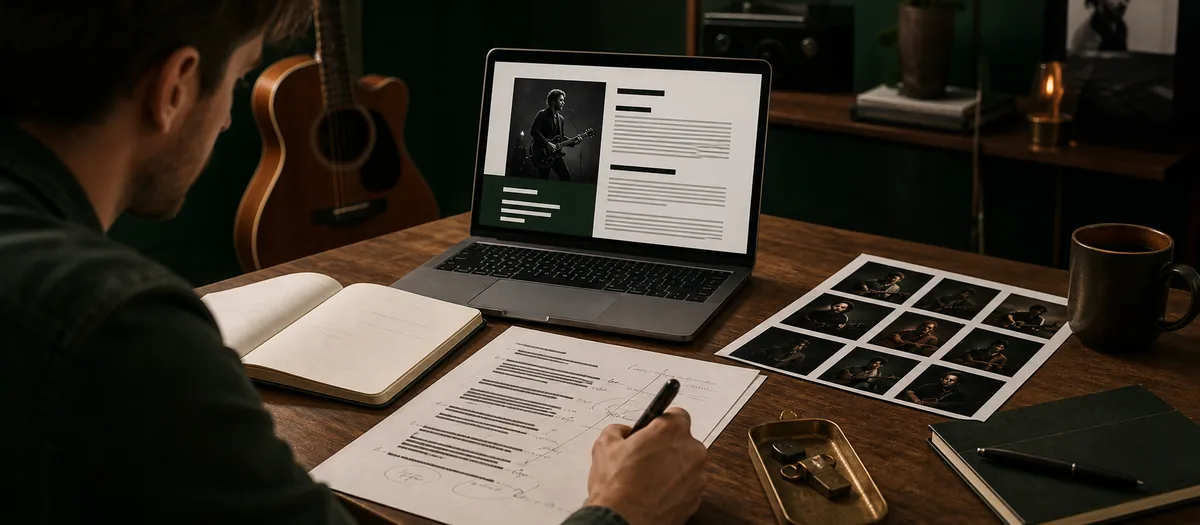
Build the first draft from four parts: identity, sound, live experience, and proof. Put the information a venue needs first, then add story only when it helps someone remember or describe the act.
A practical structure is: [Artist] is a [location]-based [act format] playing [specific sound or repertoire]. The live set creates [room experience] for [best-fit venues or audiences]. [Relevant proof]. [Current booking focus or contact direction].
Short bio example for a solo acoustic musician
Maya Lane is a Harrisburg-based solo acoustic artist performing warm pop, folk, and familiar singalong covers. Her compact two-to-three-hour set is built for breweries, patios, cafes, wineries, and restaurants that want live music at a conversation-friendly volume. She is currently booking weekday evenings and weekend afternoons throughout central Pennsylvania.
Notice that the example explains the offer without inventing awards, crowd numbers, or praise. Replace every detail with facts from your act.
Short bio example for a duo
North Street Duo brings close vocal harmonies, acoustic guitar, and a flexible mix of soul, country, and pop favorites to breweries, tasting rooms, and private community events. Based in Lancaster County, the duo performs compact two-hour and three-hour packages with a small footprint and a crowd-friendly volume.
A duo bio should clarify the instrumentation and why the configuration works for the target rooms. Add credible repeat venues or performance highlights only when they strengthen that picture.
Short bio example for a local band
The Signal Fires are a four-piece York-based cover band playing energetic rock and alternative favorites from the 1990s through today. Their live set is designed for weekend bars, breweries, festivals, and community events that want a featured band and an active room. The group provides a complete three-set show and can coordinate production requirements in advance.
If the band plays originals, say so directly and describe the types of bills, rooms, and audiences that make sense. Do not disguise an original set as a general cover-night offer.
Choose proof a local booker can evaluate
Useful proof can include repeat bookings, relevant rooms, festivals, support slots, a public performance calendar, permissioned testimonials, or a strong current live clip. Select one or two details that connect to the type of venue you are contacting.
Follower totals and streaming numbers are not automatically useful. Include them only when they are accurate, current, and relevant to the deal. Never let a number replace clear live proof.
Remove generic hype and maintain the bio
Delete adjectives that could describe any artist. Replace passionate, captivating, and unforgettable with details about sound, set, configuration, repertoire, or demonstrated experience.
Review the bio when the lineup, location, live format, strongest proof, or target venue changes. Keep the same approved short bio across your EPK, booking profile, and current outreach so venues do not receive conflicting descriptions.
Practical template
Three bio lengths to build once and reuse
One line: [Artist] is a [location]-based [act format] playing [specific sound] for [best-fit rooms or audiences].
Short bio: Add the live atmosphere, set format, and one relevant proof point in roughly 50 to 100 words.
Medium bio: Add a concise origin or story, a second proof point, and the current booking focus without repeating the same claims.
Review: Confirm every venue, number, date, quote, lineup detail, and link before publishing.
Replace every bracketed field, confirm each fact, and edit the result into your own voice before sending.
Frequently asked questions
Should a musician bio be written in first person or third person?
Third person is easy for venues, event calendars, and press pages to reuse. A first-person version can work on a personal website, but keep a polished third-person bio available for booking.
How long should a musician bio be for an EPK?
Lead with a short version that can be scanned quickly. A medium version can add context farther down the page, while a very long biography should not block the live video and booking essentials.
Can I use AI to write my musician bio?
Yes, when you provide real details and review the result carefully. Remove invented claims, generic hype, and language that does not sound like you.
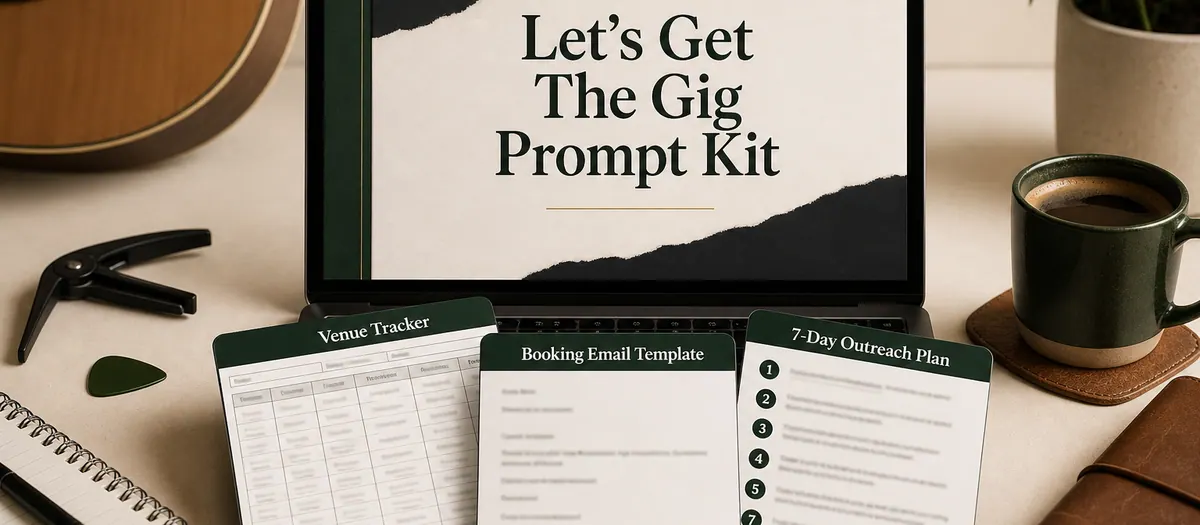
Build the complete system
Turn the advice into repeatable booking work.
The Local Gig Booking Kit includes 18 guided prompts for artist positioning, venue research, booking emails, follow-up, tracking, replies, rates, and monthly resets.